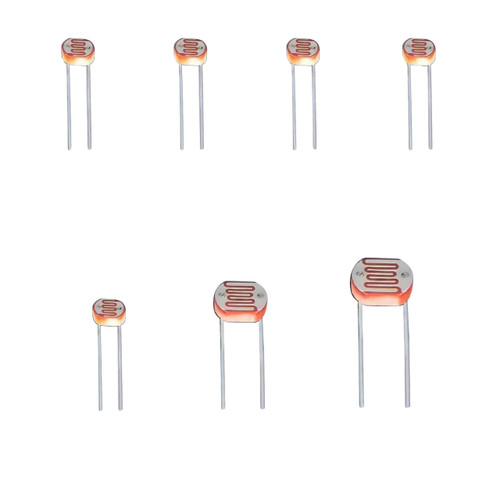
This Photoresistor / LDR Pack (5–12 mm) includes 35 pieces of Light Dependent Resistors across 7 different types, making it ideal for electronics experimentation, prototyping, and sensor-based projects.
Light Dependent Resistors (LDRs), also known as photoresistors, change their resistance depending on the intensity of light falling on them. When light levels increase, resistance decreases; in darkness, resistance increases significantly.
This kit provides multiple LDR sizes and resistance ranges, allowing engineers, students, and hobbyists to test and implement light sensing, automatic lighting, brightness detection, and smart automation circuits.
The pack includes 5506, 5516, 5528, 5537, 5539, 7528, and 12528 LDR models, covering a wide range of light sensitivity and resistance characteristics.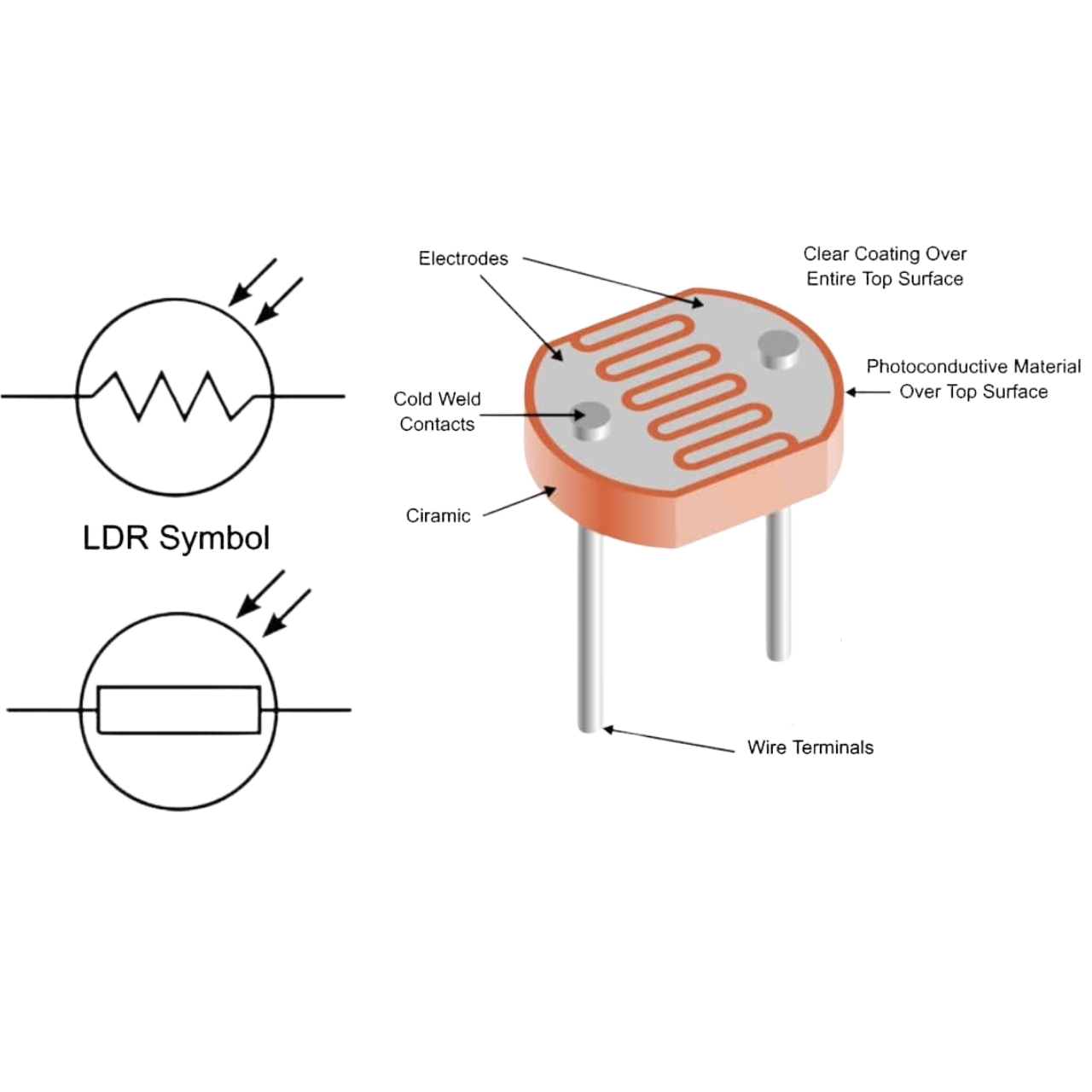
Key Features
• 35-piece LDR assortment kit
• 7 different photoresistor models
• Diameter range: 5 mm to 12 mm
• Wide resistance range for different light conditions
• Peak spectral response around 540 nm
• Ideal for Arduino, Raspberry Pi, and electronics projects
• Through-hole leads for easy breadboard use
• Perfect for light sensing and automatic control circuits
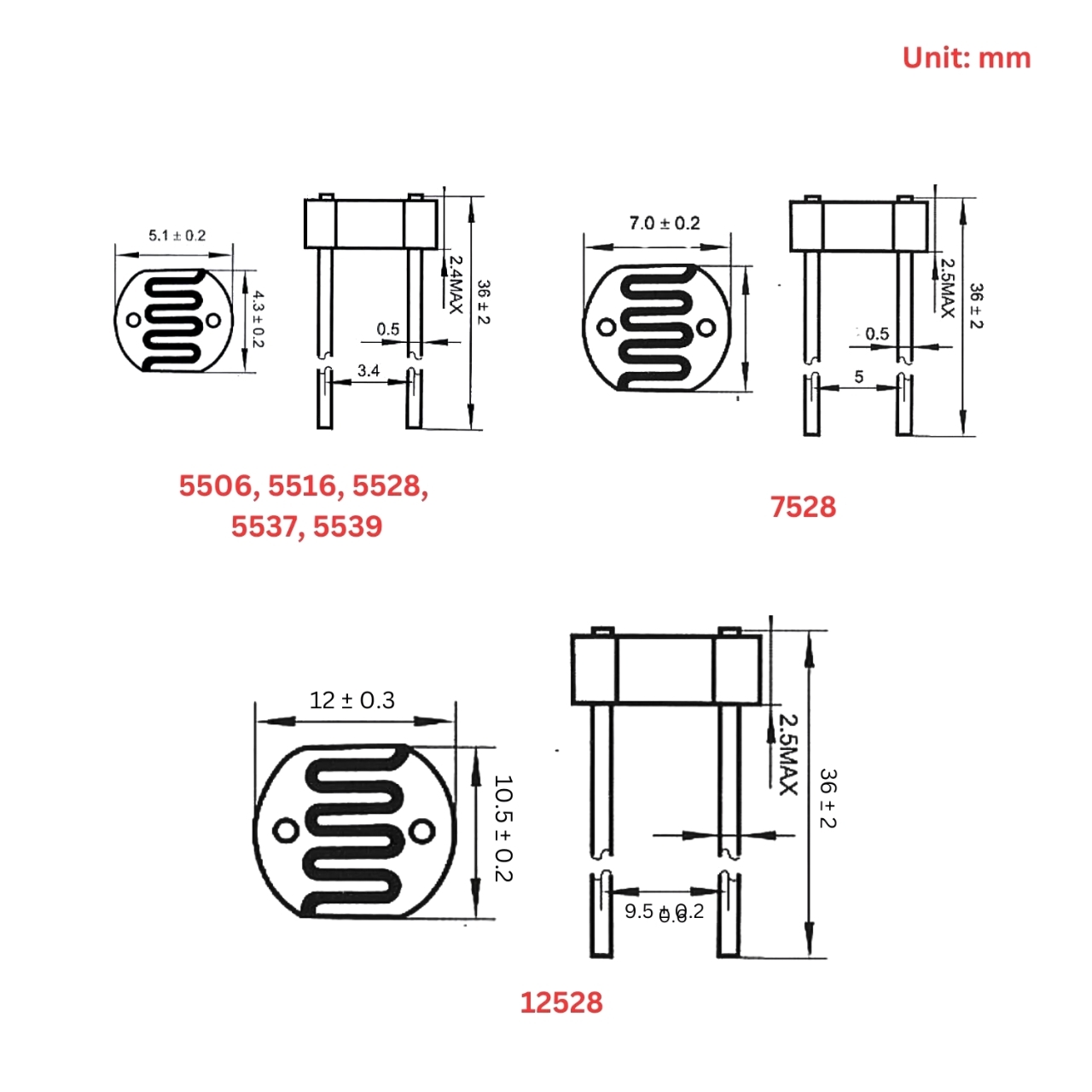
Mechanical Dimensions
Applications
• Automatic street lighting systems
• Smart home light control
• Brightness detection circuits
• Light activated alarms
• Camera exposure control
• Arduino / Raspberry Pi projects
• Educational electronics kits
• Solar tracking systems
Package Includes
35 × Photoresistors / LDR – 7 Types
• 5 × 5506 – 5mm Diameter LDR
• 5 × 5516 – 5mm Diameter LDR
• 10 × 5528 – 5mm Diameter LDR
• 5 × 5537 – 5mm Diameter LDR
• 5 × 5539 – 5mm Diameter LDR
• 3 × 7528 – 7mm Diameter LDR
• 2 × 12528 – 12mm Diameter LDR
FAQ
What is an LDR?
An LDR (Light Dependent Resistor) is a resistor whose resistance changes depending on light intensity.
How does an LDR work?
When exposed to light, its resistance decreases. In darkness, the resistance increases.
Can I use this with Arduino?
Yes. LDR sensors are commonly used with Arduino using a simple voltage divider circuit.
Are these breadboard friendly?
Yes, these LDRs have standard through-hole leads suitable for breadboards and PCBs.